Early maths learning begins long before children start solving written sums. Preschoolers develop an understanding of numbers by counting toys, comparing objects, recognising patterns and exploring their surroundings. Parents can make this learning easier by introducing simple games into everyday routines. With playful activities and regular encouragement, children can gradually build confidence in counting and develop a positive attitude towards mathematics.
Start With Counting Everyday Objects
One of the easiest ways to introduce numbers is through objects children already know. Toys, fruits, building blocks and household items can all become useful learning materials.
Try a Simple Counting Game
Place a few toys in front of your child and count them together. Touch each toy as you say its number so your child can connect the spoken number with the object.
You can also count steps while walking, crayons while drawing or pieces of fruit during snack time. Begin with small quantities and gradually increase the number of objects as your child becomes more comfortable.
Play Number Recognition Games
Recognising numbers helps children connect written symbols with the quantities they represent. Make this process playful instead of asking children to memorise numbers repeatedly.
Find the Hidden Number
Write a few familiar numbers on paper and place them around a room where they are easy to find. Ask your child to locate a particular number, such as two or five.
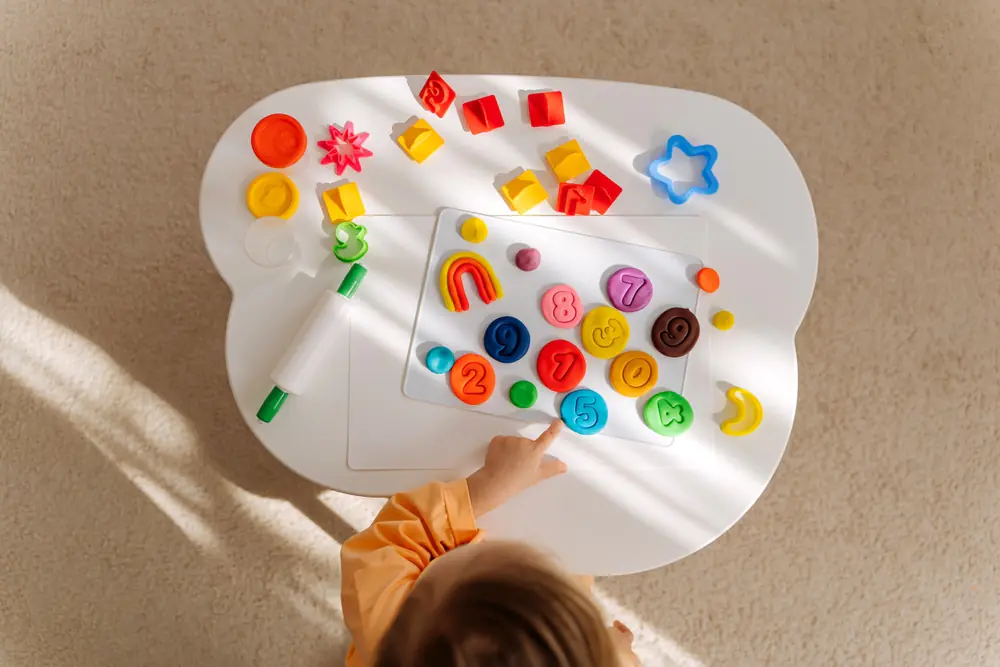
You can also use number cards, puzzles or colourful magnetic numbers. Encourage your child to say the number aloud and connect it with a group of objects.
Use Building Blocks to Teach Numbers
Building blocks are useful for introducing counting, comparing quantities and recognising patterns. They also allow children to learn through hands-on exploration.
Ask your child to build a tower using three blocks and another using five blocks. Together, compare the towers and discuss which one is taller or shorter.
You can also create simple patterns using different coloured blocks. For example, arrange one red block followed by one blue block and ask your child what colour should come next.
Introduce Simple Addition Through Play
Young children can begin exploring the idea of addition through everyday situations without using written equations.
Try the Toy Addition Game
Place two toy animals on a table and add one more. Count all the animals together to show how the total changes.
You can repeat this activity with large blocks, toy cars or other safe objects. Use small numbers and explain what happens when objects are added together.
Keep the activity informal and allow your child to move the objects while counting. The goal is to understand the concept rather than memorise calculations.
Play Sorting and Matching Games
Sorting games help preschoolers recognise similarities, differences and patterns while building early mathematical thinking.
Give your child a collection of large, colourful objects and ask them to sort them by colour, shape or size. Once the objects are grouped, count how many belong to each group.
For example, ask, “How many red blocks do we have?” or “Which group has more objects?”
These questions encourage observation, comparison and number understanding through everyday play.
Tips for Parents to Make Maths Learning Fun
Keep games short: Follow your child’s interest and stop when they become tired or distracted.
Use familiar objects: Toys, fruits and building blocks make numbers easier to understand.
Ask simple questions: Encourage children to count, compare and explain what they notice.
Allow mistakes: Gently demonstrate the correct answer without making children feel discouraged.
Avoid pressure: Children develop mathematical understanding at different rates, so let them learn at their own pace.
How Duscha Supports Early Maths Learning
At Duscha Preschool, a nurturing, Montessori-based learning environment can encourage children to explore numbers and quantities through hands-on activities. Counting materials, sorting exercises, puzzles and practical play can help young learners develop observation, logical thinking and early problem-solving skills. These experiences allow children to become familiar with mathematical concepts in an engaging and age-appropriate way.
Conclusion
Helping preschoolers understand numbers does not require complicated worksheets or formal maths lessons. Counting everyday objects, playing with blocks, sorting colourful materials and exploring simple addition can make early maths learning enjoyable.
By introducing these games regularly and encouraging curiosity, parents can help children develop number awareness and build a strong foundation for future mathematical learning.